
October 20th 2026
Two new cassava varieties yield starch over 15 tons/ha.
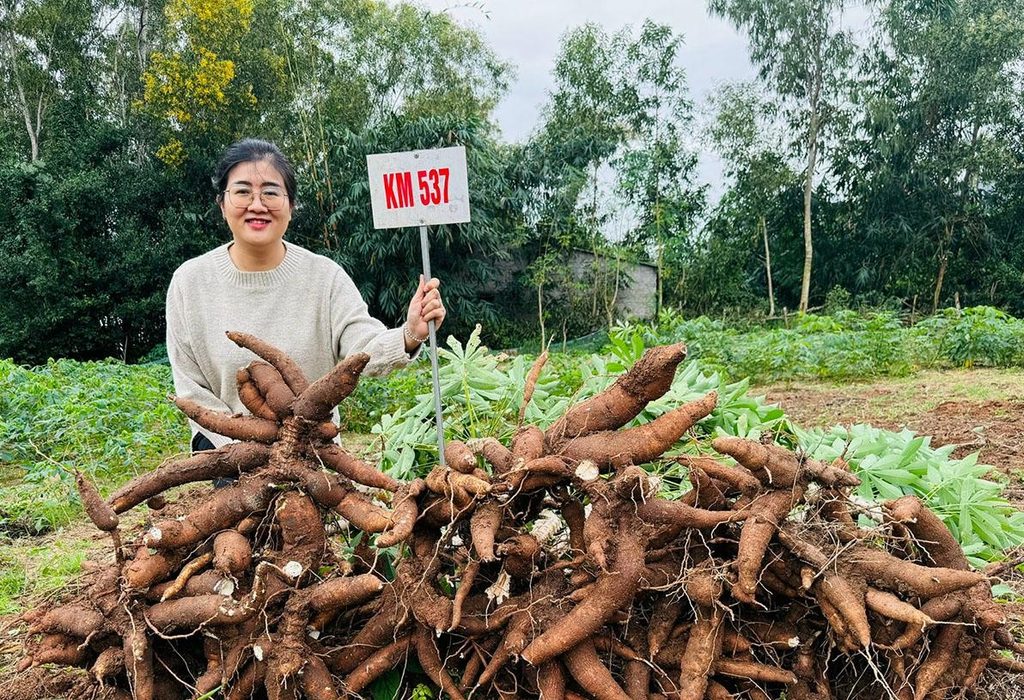
Two cassava varieties KM568 and KM537 were selected through breeding research, testing and production demonstration in Phu Yen, giving a fresh tuber yield of over 50 tons/ha. In particular, KM568 achieves a starch yield of over 15 tons/ha, and has good resistance to leaf mosaic disease and dragon buds. The research results open up the prospect of improving farming efficiency, stabilizing raw materials for processing and improving income for cassava growers.
Leaf mosaic disease and dragon buds are challenges for cassava production, affecting the yield, quality of tubers and farmers’ incomes. In this context, selecting varieties with high starch content, resistance to pests and diseases and adaptation to local farming conditions is an important research direction to improve crop value.
The project “Research on selecting and creating cassava varieties with high starch yield, resistant to major pests and diseases, suitable for production conditions in Phu Yen province” carried out by the research team of the Sub-Department of Crop Cultivation and Plant Protection in the period of 2021-2025 has focused on researching, choose to create new cassava varieties with high yield, disease resistance and suitable for local conditions. This is a necessary direction to sustainably develop the cassava industry, contributing to ensuring livelihoods and socio-economic development.
During the research process, the team has bred and improved the main cassava variety KM419 with the KM440 and C39 varieties to combine beneficial properties, especially resistance to leaf mosaic. More than 5,000 hybrid seeds were created, providing a source of material for the selection process. The team simultaneously surveyed 27 varieties and selected promising lines through many evaluation steps.
As a result, two varieties KM568 and KM537 were selected for their high yield of fresh tubers, large starch content and adaptability to local ecological conditions.
Prominent is the KM568 variety, with a fresh tuber yield of about 54 tons/ha, starch content of 28.4-28.7%, corresponding to a starch yield of over 15 tons/ha. The variety has good resistance to leaf mosaic disease and dragon shoots, is less susceptible to pests and diseases, has a compact and bulbous crown, and is suitable for intensive cultivation.
Meanwhile, KM537 yields fresh tubers of over 50 tons/ha, relatively uniform tubers and high starch content. However, the resistance of this variety to some pests and diseases is lower than that of KM568.
The results of testing on a variety of soil types and crops show that both varieties are able to adapt to the production conditions in the study area. This is the basis for continuing to improve the process of breeding, cultivation and evaluation of efficiency before expanding the area.
The effectiveness of the two new cassava varieties was verified through demonstration models in Song Hinh, Son Hoa and Dong Xuan, in the former Phu Yen province, now Dak Lak. The results showed that KM568 and KM537 had a higher yield and economic efficiency than the control variety KM94 in deployment conditions.
In parallel with building the model, the research team organized trainings, frontline conferences and workshops to transfer suitable cassava selection, propagation and cultivation techniques to farmers. Thereby, growers have more opportunities to access technical advances, improve production capacity and be more proactive in disease prevention.
Notably, the application for plant variety protection for KM568 has been accepted, setting the stage for the next steps in the development and commercialization of the variety. In order to promote efficiency, the research team proposed to put KM568 and KM537 into widespread production, giving priority to KM568; at the same time, building a system of producing disease-free stem varieties, completing technical processes and strengthening links between management agencies, scientists, businesses and farmers.
The development of high-yielding, disease-resistant cassava varieties not only contributes to improving production efficiency and stabilizing raw materials for the processing industry, but also creates more opportunities to improve livelihoods for people in rural and mountainous areas. This is also the direction of applying scientific and technological advances for sustainable production development and poverty reduction in ethnic minority and mountainous areas, in line with the objectives of the 1719 Program.
Source: https://mst.gov.vn/hai-giong-san-moi-cho-nang-suat-tinh-bot-tren-15-tan-ha-197261020010318105.htm