
July 05th 2026
Giant wheat starch granules—a leap forward in biological engineering with potential benefits for diet, manufacturing.
Scientists have grown wheat containing supersized starch granules—a leap forward in biological engineering with potential benefits for our daily diets and a raft of industrial applications.
The unique cereal starch created by the Seung group at the John Innes Center could lead to healthier, slower-digesting pasta and bread. It could also reap dividends for many multimillion-pound industries that use starch in processing and may benefit from larger granules. These include flour milling, papermaking, and the production of pharmaceuticals, cosmetics, textiles and biochemicals. The study is published in the journal Science Advances.
The biotechnological achievement fulfills a long-established ambition among researchers investigating the properties of starch, a complex carbohydrate that contributes up to 50% of our dietary calories.
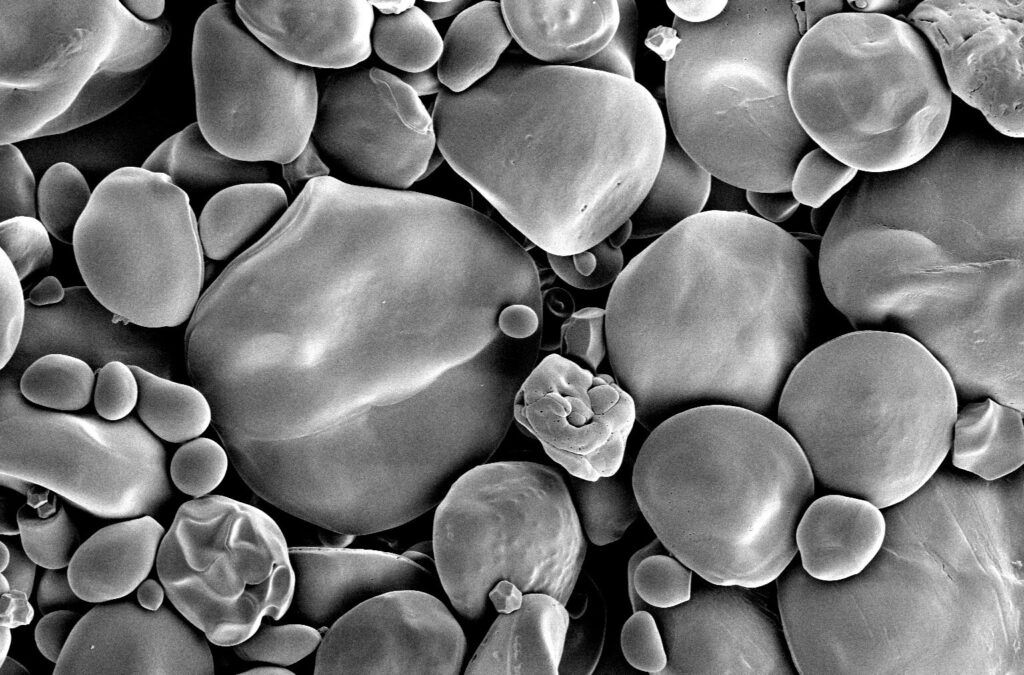
The energy-rich starch that we consume in cereals such as pasta and bread contains a mix of large, flat A-type granules and small, spherical B-type granules.
Granule size has a major influence on how we digest starch. Larger granules digest more slowly because they have less surface area available for digestive enzymes. Starch that resists digestion in the upper gastrointestinal tract is called resistant starch, a form of dietary fiber that is processed in the lower gastrointestinal tract.
This benefits the gut microbiome and avoids the sudden blood sugar spikes linked with type 2 diabetes and obesity associated with regular starches. There is also some evidence that larger starch granules enhance texture in food.
Larger starch granules offer benefits in paper manufacturing and packaging because they are easier to separate, which simplifies processing. In other industries, they assist binding and thickening properties.
However, despite these well-known benefits, the genetic factors that control starch granule size and limit starch granule growth were poorly understood.
The John Innes Center team devised experiments to develop durum wheat, used to make pasta, that might yield starch with larger A-type granules.
They discovered that two cellular factors limit starch granule size—first, the space available for granule growth in the amyloplast, the storage space for starch in wheat grains, and second, the number of granules initiated that compete for growth substrates.
They engineered plants that unblock these two limiting factors by creating a larger starch storage space and fewer granule initiations, resulting in larger granules of unprecedented scale in cereals.
Scanning electron microscopy imaging carried out at the John Innes Center confirmed that the experimental wheat plants produced A-type starch granules that were up to 50 micrometers in size, which is more than double the typical size of 20 micrometers. More than half of the granules were 30 micrometers in size, compared with just 6% in regular wheat starch.
“We were hoping our hypothesis would be correct, that with both a larger space to grow and less competition for substrate, we would get bigger granules—but we were totally surprised by quite how big the new granules were. We even needed to adjust the aperture on the particle size analyzer to capture the full scale,” said Rose McNelly, first author of the study.
The pasta wheat plants engineered to have larger starch granules were produced using traditional breeding methods with a TILLING mutant population at the John Innes Center.
This resource enabled the team to select plants with mutations in the two genes controlling amyloplast size and granule initiation and then breed new double-mutant plants combining both these traits.
There is only minor natural variation among wheat cultivars in starch granule size, which is why the engineering approach in this study was necessary. The findings primarily apply to cereal crops such as wheat and barley, which contain this unique combination of A-type and B-type granules.
The aim of the Seung group, and colleagues at Quadram Institute, is to create pasta made from plants containing these larger starch granules and test them in human trials to see if they are resistant to digestion with all the benefits that follow. This study is a proof of concept that could also be applied to bread wheat.
“We set out to prove an idea that conceptually makes sense. Often in biology things do not always work like that, but in this case it did, completely exceeding our expectations,” McNelly said.
“It’s a perfect example of fundamental science that may in future be useful for public dietary health and industry,” she added.
Dr. Fred Warren, a group leader at Quadram Institute and a co-author on the paper, said, “Variation in starch granule size within a single cereal crop is highly novel, and we do not yet know what the impact may be on food digestion and the gut microbiome. At Quadram Institute we are working with the John Innes Center to understand what the implications of this could be for the development of novel foods with additional health benefits.
“By generating foods such as pasta from this material we can explore if there is the potential to gain benefits such as reduced postprandial glycemia or improvements in gut microbial diversity from consuming these engineered starches.”
Publication details: Rose McNelly et al, Targeting granule initiation and amyloplast structure to create giant starch granules in wheat, Science Advances (2026). DOI: 10.1126/sciadv.aeh2735. www.science.org/doi/10.1126/sciadv.aeh2735
Source: https://phys.org/news/2026-07-giant-wheat-starch-granules-biological.html