
May 07th 2025
Oxford University biostimulant could boost wheat yields.
Enhancing wheat plants’ sugar signaling ability could deliver increased yields of up to 12% — besting annual yield increases currently being achieved through breeding, according to U.K. researchers from Rothamsted, Oxford University and the Rosalind Franklin Institute.
The effect was achieved by applying a Trehalose 6-phosphate (T6P) pre-signaling molecule to the plants. T6P is a signaling molecule that regulates the plant equivalent of “blood sugar” and is a regulator of metabolism, growth and development including activating the pathway for the synthesis of starch — the world’s most significant food carbohydrate.
The link was discovered during research started at Rothamsted in 2006. Now a four-year-long field study using plots in Mexico and Argentina has confirmed that the new technology could deliver major yield improvements, according to the researchers.
“Wheat has complex genetics and targeting genetic bottlenecks in germplasm makes improvement through breeding far from straightforward,” researchers stated.
“A chemical application of T6P acts as a switch for starch biosynthesis in grain, which forms the basis of wheat yields. This in turn this stimulates photosynthesis in the flag leaf, due to greater demand for carbon building blocks for grain filling.”
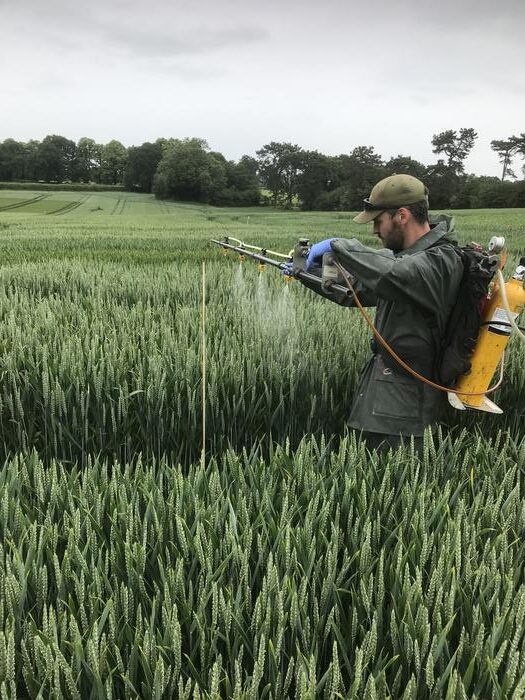
Experiments in controlled environments looked promising, but researchers said this new study shows the application can deliver in field conditions.
Not only did T6P increase wheat yields in each of the four years in the trials in Argentina and in an additional year at in Mexico, but it did so irrespective of rainfall — the major uncontrolled abiotic factor that limits crop yields globally.
Researchers noted that it may even be possible to reduce fertilizer applications as T6P treatment activates genes for amino acid and protein synthesis in grain as well as the pathway for starch synthesis.
This is important because a major issue in new higher-yielding wheat varieties is dilution of protein content requiring increased fertilizer to maintain quality for bread making.
“The path from discovery to translation has taken 25 years,” said Rothamsted’s Dr. Matthew Paul who led the research with professor Ben Davis at The Rosalind Franklin Institute and Oxford University.
“Such timeframes are not untypical in blue-skies plant research, but we do hope new technologies, such as AI and faster analytical techniques, can accelerate this process. We will need many more innovations like this to create sustainable and resilient agriculture in the coming decades.”
Rothamsted and Oxford have created SugaROx, a spinout company, to deliver this research to farmers.
“This work provides an excellent example of a case where direct selective manipulation of key molecular structures, rather than genetics or gene editing, inside a living system is a game changer,” Davis said.
“It has been very inspiring to design and discover this new class of ‘drug for plants’ together.”
Source: https://www.michiganfarmnews.com/a-12-boost-for-wheat-yields-it-s-possible-through-sugar-signaling